When most people think about an SUV, they picture something practical, comfortable, and spacious enough for everyday life. But not every SUV is designed with the same priorities.
Some are built primarily around commuting, family transportation, and fuel efficiency. Others are designed to handle more demanding conditions, whether that means rough roads, outdoor adventures, towing, or travelling beyond the pavement.
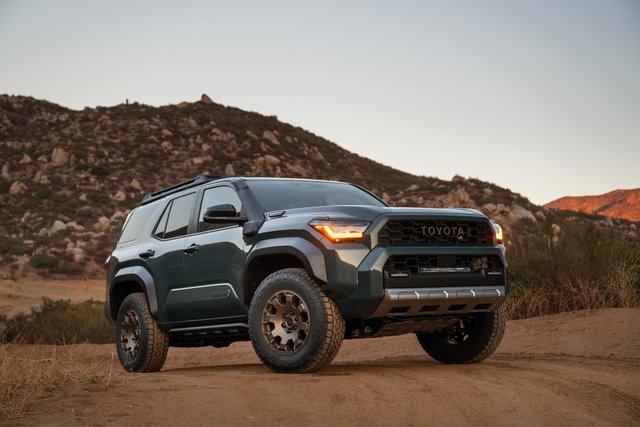
The Toyota 4Runner has always occupied a distinctive place in that conversation.
Rather than following the traditional crossover SUV formula, the 4Runner takes a more truck-inspired approach to capability. Its body-on-frame construction, available four-wheel-drive systems, specialized suspension components, and off-road technologies give it a personality that is different from many other vehicles in its category.
But what does that actually mean for drivers?
1. It Starts With Body-on-Frame Construction
One of the biggest differences between the Toyota 4Runner and many modern SUVs is how it is built.
Most crossover SUVs use unibody construction, where the body and frame are integrated into a single structure. The 4Runner uses body-on-frame construction, meaning its body is mounted onto a separate frame.
This is a design commonly associated with pickup trucks and traditional off-road SUVs.
The 2026 4Runner is built on Toyota's TNGA-F platform, which it shares with vehicles such as the Tacoma, Tundra, Land Cruiser, and Sequoia.
So why does this matter?
A body-on-frame design provides a foundation intended to handle demanding conditions, including rough terrain and towing. It also gives the 4Runner a different structural character compared with a typical crossover.
That doesn't mean one construction method is automatically better for every driver. Unibody vehicles can offer advantages in everyday ride comfort, packaging, and efficiency. The 4Runner simply follows a different engineering approach, one that places a strong emphasis on capability.
2. Capability Is More Than Ground Clearance
When people discuss off-road vehicles, ground clearance is often one of the first specifications mentioned.
While it is important, it is only one part of the equation.
The 4Runner's available off-road equipment can include features such as a locking rear differential, Multi-Terrain Select, Crawl Control, Downhill Assist Control, and specialized suspension components, depending on the model.
These systems are designed to help the vehicle manage different driving conditions.
Multi-Terrain Select allows the driver to choose settings suited to different surfaces, adjusting vehicle responses to help manage traction.
Crawl Control is designed for low-speed driving over challenging terrain. It helps manage throttle and braking so the driver can concentrate more on steering and choosing a path.
Downhill Assist Control helps regulate vehicle speed when descending steep slopes.
A locking rear differential can help improve traction when one rear wheel has less grip than the other.
These features are particularly relevant for drivers who regularly encounter challenging trails or uneven surfaces. For someone whose driving is almost entirely on paved roads, they may be less important.
The difference is that the 4Runner offers engineering intended to support more than ordinary highway and city driving.
3. Two Powertrain Options, Different Character
The 2026 Toyota 4Runner offers both a traditional gasoline powertrain and Toyota's i-FORCE MAX hybrid system.
The standard i-FORCE engine is a 2.4-litre turbocharged four-cylinder producing 278 horsepower and up to 317 lb-ft of torque.
For drivers looking for additional output, the i-FORCE MAX hybrid combines a turbocharged 2.4-litre engine with an electric motor to produce 326 system horsepower and 465 lb-ft of torque.
That torque figure is particularly relevant to a vehicle designed with capability in mind.
Torque is the twisting force that helps a vehicle accelerate and move a load. Having substantial torque available can be useful when towing, climbing, or navigating demanding terrain.
The hybrid system also introduces an additional layer of efficiency-focused technology, using electric assistance as part of the powertrain.
It is worth remembering that the 4Runner's hybrid system is not a plug-in hybrid. It does not need to be connected to an external charger. The vehicle manages its hybrid battery through its operating systems and regenerative braking.
4. Four-Wheel Drive Is Part of the 4Runner's Identity
Not all four-wheel-drive systems operate in exactly the same way.
Depending on the 4Runner grade, drivers can find on-demand or full-time four-wheel drive.
On-demand systems allow the vehicle to engage four-wheel drive when conditions call for it, while full-time systems are designed to provide four-wheel-drive operation continuously.
The distinction matters because different drivers have different needs.
Someone who frequently travels on gravel roads, encounters snow-covered routes, or ventures onto trails may appreciate the additional traction options available.
For everyday driving, however, it is important to remember that four-wheel drive does not replace appropriate tires or careful driving. It can help the vehicle move with traction, but it does not eliminate the need to manage speed and stopping distance.
The 4Runner's drivetrain options are another example of how the vehicle is designed around a wider range of driving conditions than a typical commuter-focused SUV.
5. The Suspension Is Designed With More Than Smooth Pavement in Mind
Suspension plays a major role in how a vehicle handles bumps, uneven surfaces, and changing road conditions.
The 4Runner offers different suspension setups depending on the trim.
For example, TRD Off Road models feature Bilstein shock absorbers, while the TRD Pro uses FOX shock absorbers with manually selectable damping settings.
The Trailhunter takes another approach, featuring Old Man Emu shock absorbers as part of its adventure-focused equipment.
These differences are not simply cosmetic.
Suspension components influence how the vehicle responds to bumps, how its wheels maintain contact with the ground, and how it behaves when the surface becomes uneven.
The various 4Runner grades allow buyers to choose a configuration that better reflects how they intend to use the vehicle.
6. It Is Still Designed for Everyday Life
With all this talk about off-road capability, it would be easy to assume the 4Runner is only intended for outdoor enthusiasts.
That would overlook a large part of its appeal.
The 2026 4Runner offers a choice of five- or seven-passenger seating configurations, depending on grade. It also includes modern connectivity features, available premium interior equipment, and Toyota Safety Sense 3.0.
Its available technology includes wireless Apple CarPlay and Android Auto, while higher grades offer features such as a larger multimedia display, heated and ventilated front seats, and additional convenience systems.
Another distinctive feature is the power rear window, which allows the rear glass to lower independently.
This is a long-standing 4Runner feature that provides convenient access to the cargo area and gives the vehicle some additional versatility when carrying longer items or enjoying fresh air.
The 4Runner's interior is designed to balance functionality with comfort, making it suitable for everyday use as well as occasional adventures.
7. Towing Is Another Part of the Picture
The 4Runner's truck-inspired construction also contributes to its towing capability.
For 2026, gasoline models are rated to tow up to 6,000 pounds, while i-FORCE MAX hybrid models are rated up to 5,800 pounds.
That can make the 4Runner relevant for drivers who need to bring along recreational equipment, a trailer, or other properly rated loads.
However, towing capacity is only one part of choosing a vehicle for towing.
Trailer weight, cargo inside the vehicle, passenger weight, hitch equipment, and other limits all matter. Drivers should always consult the owner's manual and vehicle specifications to confirm that a particular setup is appropriate.
The important point is that towing is part of the 4Runner's overall design, rather than an afterthought.
8. The 4Runner Offers Different Versions of the Same Philosophy
One of the interesting things about the 4Runner lineup is how much its character can change depending on the grade.
The TRD Sport emphasizes a sportier appearance and suspension setup.
The TRD Off Road Premium brings additional off-road equipment, including a locking rear differential and specialized terrain technology.
The TRD Pro is designed around more specialized off-road hardware, while the Trailhunter focuses on equipment suited to extended adventures beyond the pavement.
At the other end of the lineup, the Limited and Platinum grades introduce additional comfort, convenience, and premium features.
This variety is important because not every 4Runner buyer has the same idea of adventure.
For some, it might mean a weekend camping trip. For others, it could mean towing equipment, travelling rural roads, or simply owning an SUV with a more traditional truck-based foundation.
A Different Kind of SUV
The Toyota 4Runner stands apart because it approaches SUV capability from a different direction.
Its body-on-frame construction, available four-wheel-drive systems, specialized suspension options, and substantial torque give it a foundation suited to more demanding uses.
At the same time, modern technology, available comfort features, and flexible seating arrangements make it more than a vehicle designed exclusively for the trail.
It is not necessarily the right fit for every driver, and that is part of what makes understanding its design so important.
The 4Runner is built for people who want an SUV that can handle everyday responsibilities while offering additional capability when the road becomes less predictable.
Sometimes, the biggest difference between SUVs isn't how they look or how much space they have.
It's what they were engineered to do.